Rentals Spokane: How to Book Party Equipment Without Regretting It
I have set up inflatables and party equipment in backyards, church lots, school fields, and cul-de-sacs around Spokane for years. The same handful of mistakes show up again and again, and almost all of them are avoidable if you ask the right questions a few weeks before the event. This is what I tell friends and clients when they ask how to rent well in this city.
Start With the Space, Not the Theme
People pick a unicorn castle or a giant slide and then find out it does not fit. Measure your setup area before you look at a single catalog photo. A standard residential bounce house needs roughly 15 by 15 feet of flat ground, plus about three feet of clearance on every side for safety and for the crew to work. A large water slide can need 40 feet of length or more, and an obstacle course can run 30 to 50 feet.
Check overhead too. Power lines, low tree branches, and roof eaves are the things people forget. You want at least 10 to 12 feet of clear height for most units. I have turned down placements in Spokane Valley driveways because a single power line crossed right where the unit would stand, and no amount of creativity fixes that.
Know Which Kind of Rental You Actually Need
Bounce houses, water slides, and obstacle courses serve different groups. A bounce house suits kids from about 3 to 10 and works for mixed ages when you set a limit on how many jump at once. A water slide is better for kids 6 and up, and it dominates once the temperature passes 80 degrees. An obstacle course works well for school events, field days, and groups with a wide age spread, since kids can race in teams and adults get involved too.
If you have toddlers and older kids at the same party, think about two smaller units rather than one big one. One large unit with both groups inside is how a four-year-old gets knocked over by a ten-year-old. It costs more, but the party runs better.
Plan Around Spokane Weather
Spokane summers are dry and hot, which makes water slides popular from late June through August. But the shoulder seasons are unpredictable. A May birthday can open at 52 degrees and windy. Wind is the factor that matters most for inflatables. Most manufacturers say to stop use when sustained winds hit around 15 to 20 mph, and a reputable company will enforce that rule even if the host wants to keep going.

Ask any provider what their weather policy is before you pay. You want to know whether they reschedule, refund, or credit you if conditions are unsafe. Rain alone is usually not a problem for a dry bounce house in light drizzle, but lightning ends the day. Also ask about the time of day. Afternoon winds in the Inland Northwest often pick up after 2 p.m., so a morning start can be the safer choice.
Understand What the Price Includes
Quotes vary, and the lowest number is rarely the cheapest outcome. Typical rates in this region run roughly $100 to $200 for a standard bounce house for a day, and $175 to $350 or more for larger water slides and obstacle courses. Look for what is bundled: delivery, setup, takedown, anchoring, blower, extension cords, and safety mats.
Ask these questions before you book:
- Is delivery and setup included, or billed separately?
- Is the rental all day, or a fixed number of hours?
- Is there a surcharge for grass, concrete, or longer distances?
- What is the deposit, and when is it refundable?
I have watched a $120 rental turn into a $210 bill because of fees nobody mentioned. Get the total in writing.
Insist on Professional Setup and Anchoring
This is the part I care about most. An inflatable is a big sail filled with air, and it has to be staked or weighted correctly. On grass, a proper setup uses stakes at every anchor point, usually six or more depending on the unit. On concrete or asphalt, it uses sandbags or water weights, and the weight needed is significant.
A crew that arrives, checks the ground for sprinkler heads and rocks, lays a tarp, anchors every point, and runs a safety walkthrough with you is doing the job properly. If someone drops a unit off and says, "It should be fine," send it back. Injuries from inflatables overwhelmingly come from poor anchoring, overcrowding, and wind, not from the equipment itself.
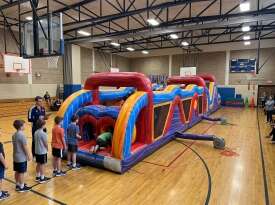
When I help people compare options, I suggest they search for bounce house rentals near me and then look closely at whether the listing mentions professional setup, all-day rental windows, and delivery coverage across Spokane and the surrounding area. Those three details tell you more about a provider than the photos do.
Handle Power and Water Before the Truck Arrives
Every inflatable needs a blower, and a blower needs a dedicated outlet. Most units draw between 8 and 13 amps. If you plug a blower into the same circuit as a refrigerator or a space heater, you will trip a breaker mid-party. Locate your outlet ahead of time and tell the provider how far it is from the setup spot. Crews typically carry 50 to 100 feet of heavy-gauge cord, but it is better to confirm.
Water slides add another need: a garden hose with decent pressure, and a place for water to drain. I have seen backyards turn into mud pits because the runoff pooled against a fence. Choose a spot with a slight slope away from the house, and warn the neighbors if the run-off could reach their yard. If your water pressure is low, mention that early, since some slides use a continuous flow and others use a pooled landing area.
Set Safety Rules and Actually Enforce Them
A good provider gives you a rules sheet. Read it, then assign one adult to watch the unit for the whole event. Not "keep an eye on it while you chat," but a person whose only job is to stand by the entrance. Rotate that job every 30 minutes so nobody burns out.
The rules that matter most are simple. Shoes off, no sharp objects, no food or gum inside, and group kids by size. Limit capacity to what the manufacturer's label says, which is usually listed by weight as well as headcount. Ban flips and rough play. When wind picks up or a storm moves in, deflate and wait. I have never regretted ending a session early, and I have regretted every time someone insisted on staying in too long.
Book Early and Confirm in Writing
Saturdays from May through September fill up fast, and popular units go first. For a summer weekend, I book four to six weeks ahead. For graduation season, school fundraisers, or holiday weekends, I go earlier. Weekday and Sunday slots are easier to get and sometimes cheaper.
After you book, confirm these things by email: delivery window, setup location, power access, the pickup time, and the cancellation policy. The day before, check the forecast and text the provider if conditions look doubtful. Then, on the day, walk the yard with the crew, point out sprinklers and hazards, and ask them to show you how the unit shuts down in an emergency.
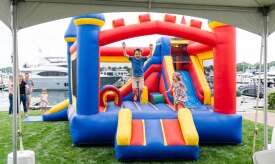
Renting equipment is not complicated, but it rewards a little planning. Measure the space, match the unit to the guests, read the weather policy, and insist on a proper setup. Do those four things and the party largely takes care of itself, which is exactly what you want when twenty kids are running toward a giant inflatable.